
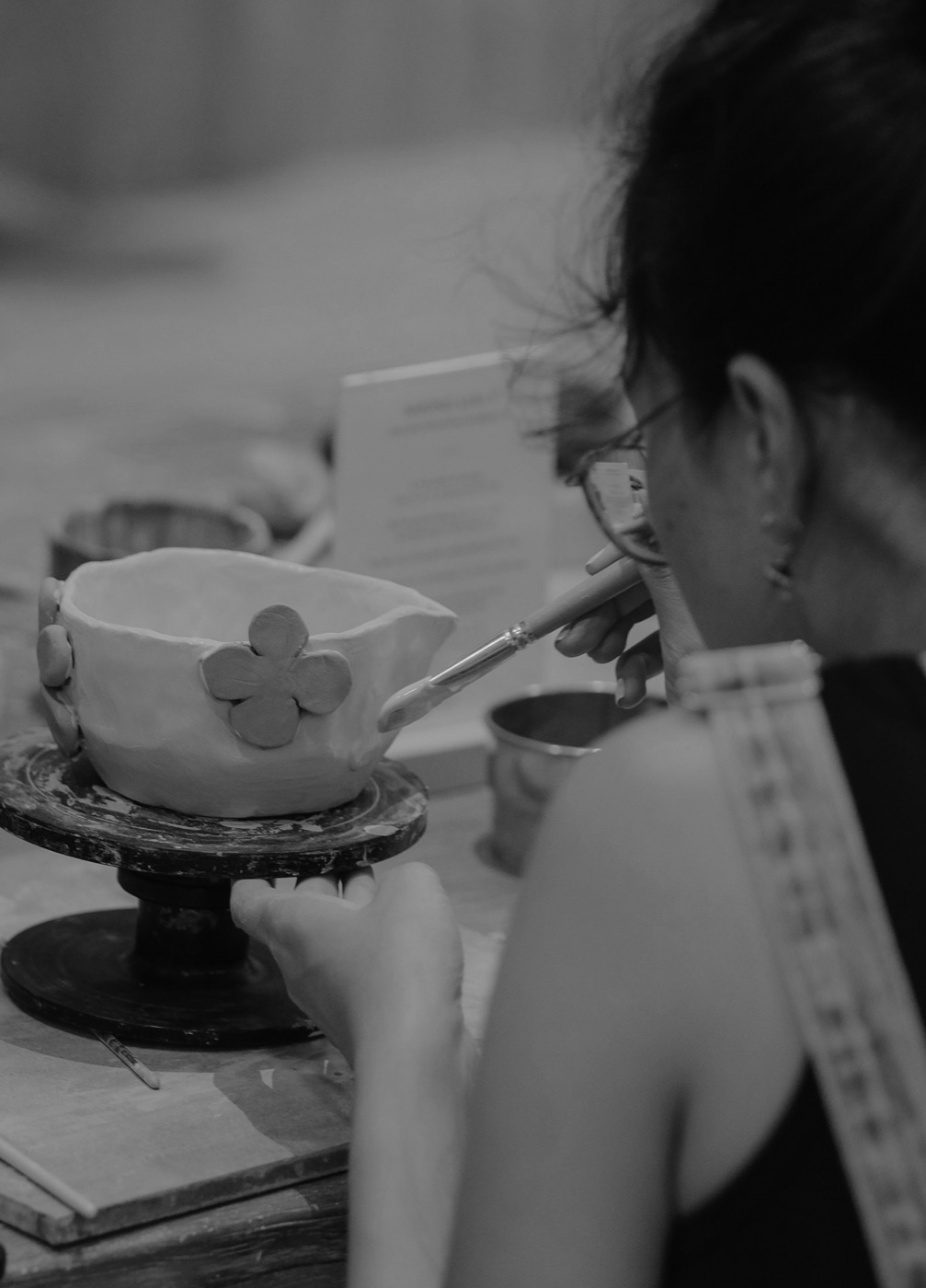
Photo: Pew Nguyen
Fiction, real economics
Three Stories
What would happen if a musician, a ceramicist, and a small studio collective became Artist Corporations? These are fictional scenarios with real economics.
These are fictional scenarios based on real economics. They are not promises or advice; they are models for what changes when creative work has a structure built for it.

A Musician
Singer-songwriter and producer · 8 years in
Photo: Nicholas Jeffries
She writes, produces, and performs her own music. She has a small but devoted audience: 1.2 million Spotify streams per year, a mailing list of 4,000, and she plays about 40 shows annually. She makes $72,000 a year before expenses. Not bad. Not great. She's been at roughly this level for three years.
Here's how that $72,000 breaks down: $4,800 from streaming (at roughly $0.004 per stream), $28,000 from live shows, $14,000 from sync licensing and placements, $18,000 from merch and direct sales, and about $7,200 from Patreon and fan support.
After expenses — $8,400 for health insurance (she's on an ACA marketplace plan), $6,000 for her studio space, $4,200 for gear and software, $3,600 for marketing, and $2,400 for travel — she nets about $47,400. No retirement savings. No equity. No safety net. If she gets sick for three months, the income stops.
Year 3: The Offer
An indie label approaches her. They want to sign her. The deal: they'll advance $30,000 for her next album, handle distribution, and put marketing dollars behind her. In exchange, they want her master recordings and an 82/18 split on recording revenue — 82% to the label. They also want a 3-album commitment. Her manager (who takes 15% of gross) says it's a good deal for someone at her level.
She knows the advance is really a loan recouped from her royalties. She knows that if her music gets placed in a TV show five years from now, 82% of that goes to the label. She knows that if she wants to leave after album two, she can't — and her masters stay with them regardless.
What She Does Instead: An A-Corp
She forms an A-Corp. She holds 80% of voting shares. Her long-time collaborator and co-producer gets 20% — both are artists under the statute, satisfying the 51% rule. She issues a separate class of economic-only shares to raise $35,000 from two supporters: a family friend puts in $20,000 and a local music investor puts in $15,000. They get a right to 15% of net revenue for 7 years. They get no vote. No creative control. No ownership of her masters.
Her masters and all recordings are assigned to the A-Corp with statutory reversionary rights. If the company ever dissolves, or if the IP is ever at risk of transfer to a non-artist, it reverts to her automatically. This isn't a contractual promise — it's Colorado law.
The A-Corp's stated artistic mission: "To create, record, and perform original music." This mission has primacy over financial return in the company's articles.
Ten Years Out
If she signed the label deal
As an A-Corp
Assumes 10% annual revenue growth, catalogue valued at 10x annual royalty income, SEP-IRA contributions of 15% of salary. Her 80% ownership stake means she holds 80% of the company's growing value.
The musician keeps her masters. The ceramicist keeps creative control. The collective’s four artists get health insurance and retirement for the first time. None of this requires new technology or extraordinary success — just a legal structure designed for the way artists actually work.
These profiles are fiction. The economic figures are modeled on real data: streaming rates from industry reports, health insurance costs from ACA marketplace averages, standard industry splits for labels and management, and growth assumptions consistent with the A-Corp calculator methodology. This is not financial or legal advice. Actual outcomes depend on individual circumstances. See our methodology for detailed assumptions.